 1320 Upland Drive Houston, TX 77043
 281-948-2913

December at Bush Intercontinental runs a normal high of 65.3 degrees and a normal low of 45.6, according to the National Weather Service climate record for Houston. The air your calibration was finished in was nothing like that. The gap is big enough to change how a tuned car behaves on the way to work, and most owners in Houston, Katy and Cypress feel it before they understand it. The car feels livelier, it pulls harder in third, and then one cool morning it stores a code it has never stored in August.
Quick Summary: Key Takeaways
- Cold air is denser air: the same boost target now pushes more mass through the engine, so the load the calibration sees goes up.
- Overboost cuts cluster in winter: a wastegate that was lazy in the heat suddenly holds too much pressure in 45-degree air.
- Fuel delivery is the first limit: high-pressure fuel pump duty climbs with the extra airflow, and a pump near its ceiling in summer has nothing left in December.
- A datalog settles it in twenty minutes: requested versus actual boost, ignition correction per cylinder, rail pressure deviation and intake temps.
- Fix the supporting hardware first: more power on a system already at its limit is how parts break.
Denser air means more load at the same boost number
Boost is a pressure reading, and pressure alone does not tell you how much air the engine swallowed. Drop the intake temperature forty degrees and the same 18 psi carries noticeably more oxygen into the cylinder. The engine makes more power for free, and the calibration has to cover that with more fuel and sometimes less timing.
On a stock car the factory tables handle the swing without complaint. On a tuned car the margins are thinner because somebody already spent them. A map written around heat soak in a Houston August is working with a different airflow curve in December, and the places it runs out of room are the places that were already close.
The faults that turn up first on cold mornings
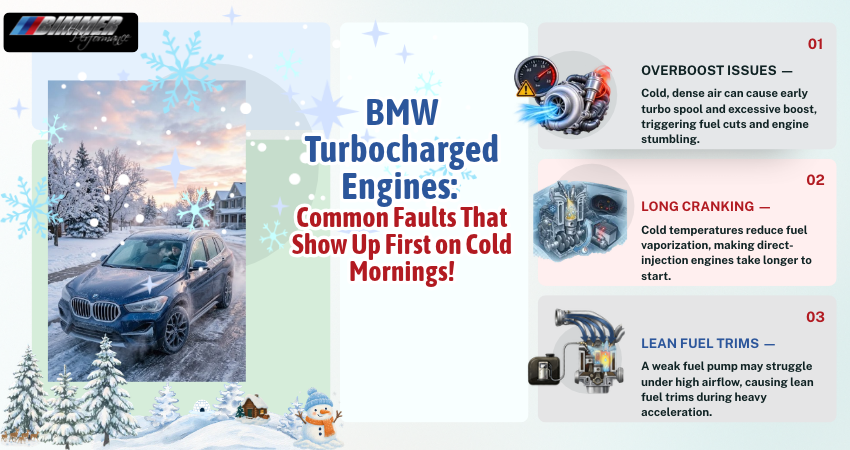
Overboost is the common one. Cold, dense air makes the turbo spool earlier and hold longer, a wastegate that leaked a little pressure in the heat now seals well enough to overshoot the target, and the ECU cuts fuel to protect the engine. You get a stumble at the top of third gear and a stored code.
Long crank times are the second. Cold fuel vaporizes less readily, so a direct-injection engine that lit immediately in July can turn over several times in December. Measure it before you spend money, because the symptom belongs to the fuel side and the charging side both, and a log separates them in one pull.
The third one is quieter and easier to miss entirely. Fuel trims drift lean under load while everything feels fine at part throttle, because the pump only runs short of capacity when the airflow peaks.
What a log tells you that a test drive cannot
A test drive tells you the car feels strong. A log tells you what the engine asked for and what it got. Four channels do most of the work: requested versus actual boost, ignition correction per cylinder, high-pressure fuel rail deviation, and intake air temperature. Pull them over three or four full-throttle runs in gear and the picture is usually obvious within a few minutes of looking.
Ignition correction is the channel owners skip. A single cylinder pulling two or three degrees while the others sit flat points at a plug, a coil or an injector, and it points there long before the car starts misfiring badly enough to light the dash. Catching that in December costs a set of plugs. Ignoring it until spring can cost a piston.
Spend the money on the supporting parts first
Our position on this has not changed in years. If the log shows rail pressure falling away at the top of a pull, no software change fixes that, and another stage just moves the failure closer. Sort the fuel side, then talk about power.
Do the cheap items in the same visit. Plugs on a boosted engine live a hard life, and a tighter gap holds the spark better once cylinder pressure climbs. Charge pipe clamps work loose from heat cycling, and a popped coupler on the Katy Freeway feels exactly like a blown turbo. Change oil that is well past its service interval before you add load to a direct-injection engine.
Frequently Asked Questions
Q: Does my BMW actually make more power in cold weather?
A: Yes, within limits. Denser intake air gives the engine more oxygen per cycle, and a healthy tuned car will feel stronger in December than it did in August. The limit is whatever runs out first, usually fuel supply.
Q: Should I get a different tune for winter?
A: Most owners do not need one. A good calibration already compensates across a temperature range. Log the car once the weather turns, so you know the compensation is actually holding.
Q: Why does my tuned BMW only throw a code when it is cold out?
A: Because cold air raises airflow and load at the same throttle position. Components sitting right at their limit in warm weather get pushed past it, and the ECU logs the fault.
Winter Is the Cheapest Time to Find a Fault
Winter is the easiest time of year to find out what a tuned BMW is really doing, and the cheapest time to fix what you find. We are at 1320 Upland Drive in Houston, and you can reach us through bimmerperformancetx.com.