 1320 Upland Drive Houston, TX 77043
 281-948-2913
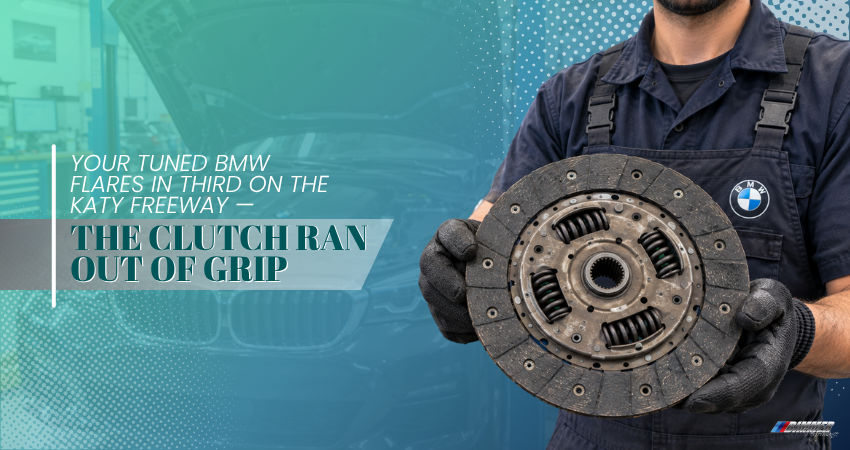
Third gear, 4,000 rpm, boost building on the entrance ramp. The tachometer jumps 400 rpm and the car does not. Then you smell it. That is a stock clutch giving up on your tune, and it is the single most common driveline complaint we see on modified BMWs in Houston once the weather turns.
October is when it starts. Cooler, denser air means more timing, more boost and more torque at the same map — so the tune that felt fine through the summer heat suddenly asks the clutch for more than it can hold. Drivers from Katy, Cypress and Sugar Land arrive with the same complaint every autumn.
Quick Summary: Key Takeaways
- Slip has a signature: Engine rpm rising faster than road speed under boost, then a burnt smell, is slip. A judder off the line is a different problem.
- Cool air raises torque: The same flash makes more power in 70-degree air than in 95-degree air, which is why slip shows up in autumn.
- Log before you buy: Requested versus actual boost and timing pulls tell you whether the tune is healthy before anyone sells you a clutch.
- Match the clutch to the target: A clutch chosen for 400 lb-ft and a clutch chosen for 600 lb-ft behave very differently in traffic on I-10.
- The clutch is not the only part: Once torque climbs, driveshaft flex discs, half-shafts and differential bushings become the next thing to fail.
A stock clutch is sized for stock torque, with very little margin
Factory clutch capacity is chosen for the factory torque curve plus a modest safety margin, and that margin is where every stage of tuning lives. A downpipe and an intercooler do not add much on their own. A flash that raises target boost across the mid-range does, because peak torque arrives earlier and stays longer, and clamping force is a fixed number that does not care about your goals.
So the disc slips at the point of highest torque — usually third gear, mid-rpm, under full boost, which is also the exact moment the car feels best and you are least likely to lift. That is physics, not a defect.
Slip, judder and a rising pedal are three different faults
Sort the symptom first. Slip is rpm climbing without speed, worst in a high gear under load, often with a smell after a pull. Judder is a shake at the moment of engagement from a standstill, which usually means the flywheel or the disc’s springs, not clamping force. A pedal whose bite point has crept upward points at a worn disc that is close to done regardless of the tune.
One more clue people miss. If slip only happens hot, after a long run down the Katy Freeway, the disc is glazed and the decision has already been made for you.
Cooler air, more boost, less margin — the autumn pattern
Heat hides it. Houston summer protects a marginal clutch by quietly costing you power. When intake temperatures fall in October, timing advances, boost holds better and torque climbs at exactly the rpm where a worn disc is weakest. Nothing changed on the car. The air changed.
Driving style compounds it. The Department of Energy notes that aggressive driving can lower gas mileage by roughly 15% to 30% at highway speeds, and every one of those launches is a slip cycle the clutch pays for. Two hard pulls a day adds up faster than 20,000 highway miles.
Chasing the tune before checking the clutch wastes money
Here is the order we recommend. Log the car first — requested against actual boost, timing corrections, fuel pressure under load. A tune pulling timing looks and feels a lot like slip, and no clutch fixes a fuelling problem. Once the logs are clean and slip is confirmed, choose the clutch for the torque target you actually run, not the number on the box.
A single-mass conversion holds more and rattles at idle. An upgraded dual-mass setup stays civil in traffic and costs some capacity. Both are correct answers to different questions, and the honest one depends on whether the car sits in Beltway 8 traffic every morning or goes out on weekends.
What we check while the gearbox is out
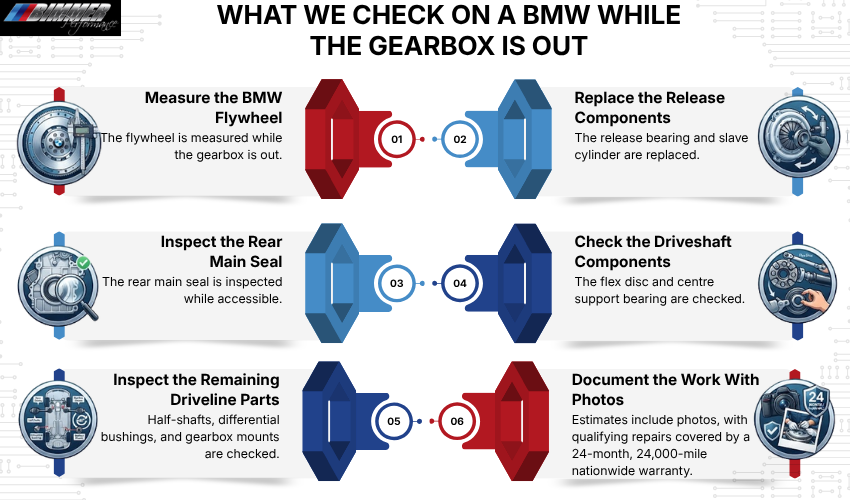
Pulling a transmission is the expensive part of the job, so nothing gets left. The flywheel is measured, the release bearing and slave cylinder are replaced, the rear main seal gets inspected, and the driveshaft flex disc and centre support bearing are checked — because the extra torque that killed the clutch has been working on those too.
Half-shafts, differential bushings and gearbox mounts get the same look. Estimates come with photos, and qualifying repairs carry a 24-month, 24,000-mile nationwide warranty. If a shuttle within five miles helps you get back to work while the car is on the lift, ask.
Frequently Asked Questions
Q: Will a Stage 2 tune destroy my BMW clutch?
A: Not instantly, but it removes the safety margin. A healthy stock clutch often survives a conservative flash for a while; a clutch with 90,000 miles on it usually starts slipping within weeks. Torque, not horsepower, is what decides.
Q: How do I know if my clutch is slipping or my tune is pulling timing?
A: Data logs. Slip shows engine rpm climbing away from road speed in a fixed gear. Timing correction shows the opposite — the car feels flat and rpm rises slowly. Ten minutes of logging separates them and stops you buying the wrong part.
Q: Should I upgrade the flywheel with the clutch on a tuned BMW?
A: If the flywheel has play or heat marks, yes. Single-mass conversions hold more torque and add idle noise; upgraded dual-mass assemblies keep the car quiet and hold less. Choose based on how the car is driven daily, not on the highest number available.
Q: What else breaks after a clutch upgrade on a tuned car?
A: The driveline behind it. Flex discs, centre support bearings, half-shafts and differential bushings all see torque they were not sized for, and a clutch that finally holds simply passes the load further back. Have those inspected during the clutch job.
Book the car in before the slip becomes a tow
Slip gets worse quickly once it starts, and a glazed disc will not recover. Bring the car to our Upland Drive shop with your logs and we will tell you whether this is a clutch, a tune, or both.
Hours: Monday to Friday, 9:00 AM to 6:00 PM. Closed Saturday and Sunday.
Website: bimmerperformancetx.com