 1320 Upland Drive Houston, TX 77043
 281-948-2913
E85 can be worth it on a tuned BMW. It comes with conditions. BMW E85 setups make extra power because ethanol resists knock, which lets a tune add timing and boost that pump 93 can’t support. You burn more fuel, the fuel system has to keep up, and the blend at the pump changes with the season, which matters most from November on for Houston owners running a Stage 1 flash, the software-only tune.
Quick Summary: Key Takeaways
- Where the power comes from: ethanol’s higher octane lets the tune run more timing and boost.
- What it costs: E85 carries less energy per gallon than gasoline, so range drops.
- What limits it: the in-tank pump, the high-pressure pump and the injectors decide how much ethanol a direct-injected B58 or N55 can use.
- What changes in winter: pump E85 can carry less ethanol in colder months, and a fixed map can’t see that.
BMW E85 Trades Fuel Range for Knock Resistance
E85 helps a tuned BMW because knock, the uncontrolled early burn that forces a tune to pull timing, is what usually caps boost on a turbo six. Ethanol has a higher octane number than gasoline, so a tune written for it can advance timing before the knock sensors pull power back.
You pay for it in range. By the Department of Energy’s figures, a gallon of 83% ethanol E85 holds roughly 27% less energy than a gallon of gasoline, and an engine making more power needs more of it again. Expect fewer miles per tank. On a car already running 93 for a Stage 1 map, decide whether you can live with that before buying a single part.
A Stock Fuel System Is the First Wall on Ethanol
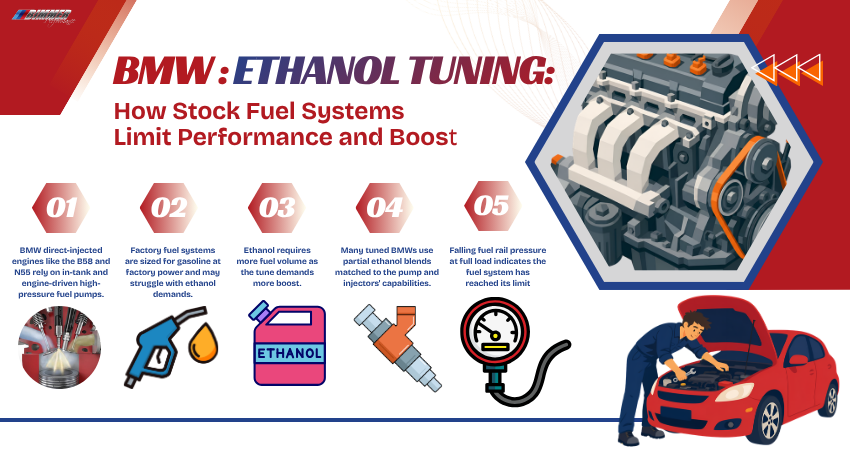
How much ethanol your BMW can use depends on the fuel system first. Direct-injected engines like the B58 in an M340i or the N55 in a 335i rely on an in-tank pump feeding an engine-driven high-pressure fuel pump, both sized for gasoline at factory power, and ethanol asks them for more volume just as the tune asks for more boost.
That’s why many tuned cars run a partial blend. A mix of pump gas and ethanol, matched to what the pump and injectors can hold at full load, keeps much of the timing benefit without starving the engine near redline. Watch rail pressure. If a datalog (a recording of sensor readings taken during a drive) shows it sagging at full load, the fuel system has hit its ceiling and more ethanol only widens the gap.
Winter Blends Change the Ethanol in Your Tank
Ethanol content in E85 isn’t fixed. It changes with the season. The Department of Energy explains that winter E85 is often blended with less ethanol, since a cold engine needs fuel that vaporizes readily enough to start, and the ASTM D5798-21 specification allows anywhere from 51% to 83% ethanol.
A flex-fuel pickup shrugs that off. A tuned BMW running a map built around one ethanol percentage can’t, because a tune expecting summer fuel adds fuel and timing for ethanol that may not all be in a December tank. And that’s the argument for an ethanol content sensor, which reads the blend as it flows and lets the tune adjust instead of trusting the pump label.
Fuel Trims and Codes Show When the Blend Is Wrong
Look at fuel trims. These are the corrections the engine computer makes to its base fueling, and a BMW usually shows a fuel mismatch there before any warning light comes on. Trims that climb toward their limit after a fill-up, a rough start on a cool Cypress morning, or a stored lean or misfire code all raise one question.
Did the blend change? Read the codes and trims with that tank still in the car, because topping up with gasoline first erases the evidence. Bimmer Performance diagnoses check engine lights with its own scanning equipment, sends estimates with photos of the fault, and only proceeds once you approve.
More Timing Puts the Clutch and Plugs on Notice
Extra timing shows up as torque, and torque finds the weakest part behind the engine. On a manual car, that’s usually the clutch. A disc that held a Stage 1 map all summer can start slipping on the first ethanol pull in cool November air.
Plugs come next. A tune that leans harder on timing is tougher on spark plugs, so check their gap and condition with every fuel change and keep a few datalogs from the first tanks.
Bring the Plan to a Houston Shop Before the First Tank
Check the car first. Before switching, have someone confirm the fuel delivery, ignition and driveline can take the torque an ethanol map is built to make. Bimmer Performance lists BM3, Burger Tuning, VRSF, Wagner Tuning and Vargas Turbos on its tuning page, along with BMW training through Worldpac classes and an Autologic scanner.
A car from Katy or Sugar Land that has run Stage 1 on 93 all summer is a good candidate for this conversation, because the datalogs from those months already show how much margin the fuel system has left.
Frequently Asked Questions
Q: Can you put E85 in a stock BMW?
A: Not as a straight fill. A stock BMW isn’t built as a flex-fuel vehicle, so check the fuel section of your owner’s manual for the most ethanol your model allows. Running E85 properly takes a tune written for it and a fuel system that can deliver the extra volume.
Q: Does E85 hurt fuel economy on a tuned BMW?
A: Yes. E85 holds less energy per gallon than gasoline, so you’ll fill up more often, and a tuned engine using its extra power burns more again.
Q: What does a flex fuel sensor do on a BMW?
A: It measures the ethanol percentage in the fuel on its way to the engine and reports it to the tune, which then adjusts fueling and timing for the blend actually in the tank.
Talk It Through Before You Switch Fuels
Still on pump 93 and only weighing ethanol? Nothing has been bought yet. That makes this the cheapest moment to find out whether your fuel pump, plugs and clutch are ready for what an ethanol map will demand of them. Your logs and your fuel plan can go to 1320 Upland Drive, Houston, TX 77043 together, and bimmerperformancetx.com shows which tuning platforms the shop already works with.