 1320 Upland Drive Houston, TX 77043
 281-948-2913
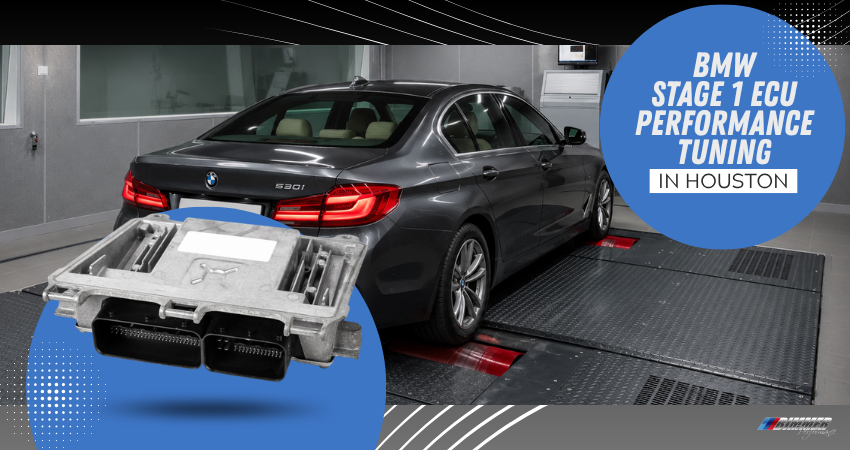
Stage 1 means software only, on stock hardware. On an N55 335i that’s roughly 60 to 70 more horsepower and 80 lb-ft of torque. A B58 M340i picks up close to 70 horsepower, with the torque curve arriving 400 rpm earlier than stock. Real numbers. Before any map gets flashed, though, a Stage 1 car needs healthy plugs, a charge pipe that won’t split, and a fuel system that can keep up with the boost you just asked for.
The U.S. Department of Energy reports that aggressive driving can lower gas mileage by 10 to 40 percent in stop-and-go conditions, which is worth remembering on the Katy Freeway at 5 p.m. A tune rewards clear road and a mechanically healthy engine.
Quick Summary: Key Takeaways
- Stage 1 defined: Software only, with no downpipe, intercooler, or hardware changes beyond maintenance parts.
- Typical gains: N55 picks up 60 to 70 hp, B58 around 70, S55 near 80 on 93 octane, all on stock turbos.
- Fix first: Cracked plastic charge pipes, plugs past 30,000 miles, and a weak high-pressure fuel pump all fail after a tune.
- Fuel matters: A 93-octane map needs 93 octane every fill, since dropping to 87 pulls timing and triggers knock correction.
- Warranty reality: Flash counters and control unit data are readable at the dealer, so assume drivetrain claims can be denied.
Stage 1 is a software change on hardware you already own
Stage 1 rewrites boost, timing, and fuel tables in the engine control unit. Nothing else changes. The turbo, intercooler, downpipe, and exhaust stay factory, which keeps the price near $600 to $1,000 for a licensed map.
Gains come from headroom BMW left on the table. Factory maps run conservative boost and timing to cover global fuel quality and emissions margin, and a good Stage 1 file takes back part of that margin. That’s the whole trick.
Power figures by engine, without the marketing
Numbers depend on the engine. N54 335i cars gain 70 to 90 horsepower because twin turbos have room. N55 single-turbo cars land at 60 to 70, and B48 230i and 330i cars pick up 40 to 55. B58 M340i owners see about 70, while S55 M3 and M4 cars come in near 80 on 93 octane. All on stock turbos.
Torque is the bigger story. A tuned N55 reaches peak torque roughly 1,000 rpm sooner, and that changes how the car feels on a Beltway 8 on-ramp far more than any dyno sheet suggests. You feel it immediately.
Three parts fail first when you add boost to a stock car
Boost finds the weak link. The plastic charge pipe on N54 and N55 engines splits at the coupler under higher pressure, so an aluminum replacement goes on before the flash rather than after. Spark plugs are next.
A tuned car wants fresh plugs every 20,000 to 30,000 miles, often one heat range colder. A high-pressure fuel pump that was already marginal shows itself as a long crank or a stumble near 5,000 rpm once the map asks for more fuel. Test it beforehand.
Tuning a neglected engine is how people break things
A tune magnifies whatever is already wrong. Carbon on the intake valves of a direct-injected N54, a leaking oil filter housing gasket, a rattling wastegate, or an 80,000-mile water pump all get worse with 3 more psi. Walnut blasting first.
Skipping the inspection is how a $900 tune becomes a $4,000 engine repair, and it’s why we won’t flash a car until the lift check is done and the fault memory is clean. No exceptions.
What a Stage 1 tune looks like at our Houston shop
The flash is the last step. Cars come in for a full inspection at 1320 Upland Drive covering compression and boost-leak testing, plug condition, charge pipe, fuel trims, cooling system, and stored faults. Then we talk fuel.
Houston sells 93 at most stations, so a 93-octane map makes sense here in a way it doesn’t in states capped at 91. We’ll also set expectations about warranty exposure before anything gets written to the control unit. Datalogs after the flash confirm timing pull, boost target, and knock activity on a real road, usually a run out toward Katy. Proof, not promises.

Frequently Asked Questions
Q: How much horsepower does a BMW Stage 1 tune add?
A: Between 40 and 90 horsepower depending on engine. B48 cars gain 40 to 55, N55 cars 60 to 70, B58 cars around 70, N54 cars 70 to 90, and S55 M3 and M4 cars near 80 on 93 octane. Torque gains are usually larger than horsepower gains.
Q: Will a Stage 1 tune void my BMW warranty?
A: It can void drivetrain coverage. Dealers can read flash counters and control unit data, and a tune-related failure is a reasonable denial. Cars still under factory warranty should weigh that risk honestly before flashing. Eyes open.
Q: What do I need to do before tuning my BMW?
A: Replace a plastic charge pipe with aluminum, install fresh plugs one heat range colder, verify the high-pressure fuel pump and wastegate are healthy, and clear carbon buildup on a direct-injected engine. Fresh oil and a clean fault memory belong on that list too.
Q: Is 93 octane required for a Stage 1 BMW tune?
A: For a 93-octane map, yes, every fill. Running 87 or 89 makes the control unit pull timing and reduce boost, and repeated knock correction is hard on pistons. Houston stations carry 93 widely, so it’s an easy requirement to meet here.
Get the pre-tune inspection before you buy a map
A Stage 1 flash is worth doing right. Bring your BMW to Upland Drive for a boost-leak test, a plug check, and an honest conversation about what your engine will hold before we write anything to the control unit.
Hours: Mon–Fri 9:00 AM – 6:00 PM; closed Saturday and Sunday
Website: bimmerperformancetx.com